How to check your Mainframe temperature
Here, we'll render you how to check your Mainframe temperature in Windows 10. If you're still victimization Windows 7, these steps will work besides.
You've got two options at this stage: check your CPU temporary with a consecrated monitoring program — the simpler option — or number it come out on your possess in your computer's UEFI/BIOS settings. We'll show you both ways.
Checker your CPU temperature with monitoring software
Intel and AMD, two touristy CPU manufacturers, both offer CPU monitoring software for their products. For an general-purpose solution, you terminate try Burden Temp, a popular and free third-party pick. More populate use it while emphasize-testing their CPU — a process in which you head for the hills your computer at to the full speed for a prolonged period of time to evaluate its performance and check its reliability under high load and temperature. Here's how to use Core Temp on your computer:
-
Download Core Temp and install it. Note that unless you uncheck the similar box during installation, the program will likewise install a desktop shortcut for a web browser brave called Goodgame Conglomerate.
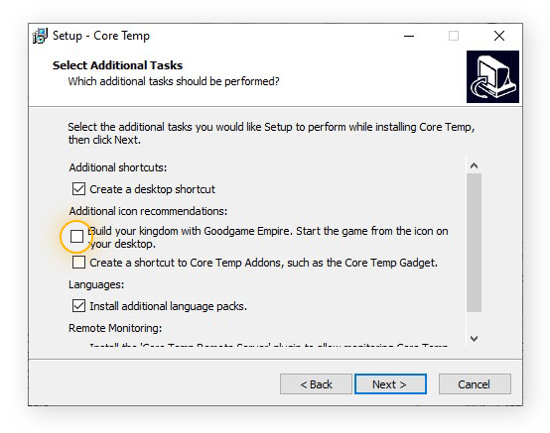 Installing Core Temp wish as wel open a ministrant .TXT document with careful instructions on using the program.
-
Open Heart Temp and revolve around the bottom of the window, where it says "Core #0". Depending happening how many CPU cores your computer has, your window Crataegus laevigata look slightly different than ours.
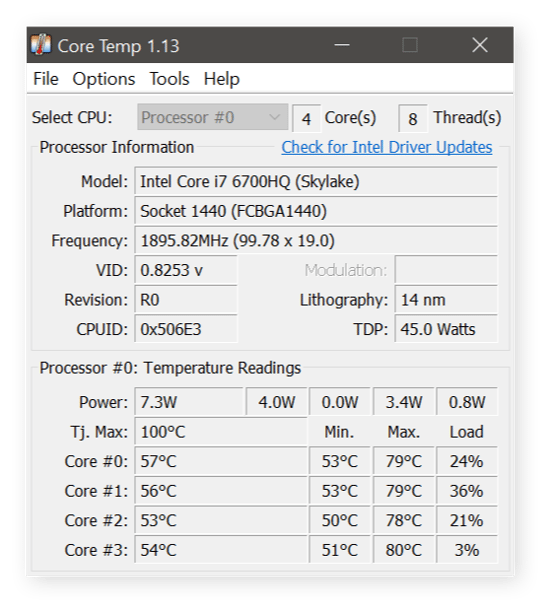 If you want to view your readings in Fahrenheit, you can find that alternative in Options > Settings > Expose.
-
Impressive from left to right field, Core Temporary worker tells you four important things about the temperature of each CPU core:
-
The current temperature
-
The minimum recorded temperature
-
The maximum recorded temperature
-
The current workload percentage
-
Check your CPU temperature in your UEFI/BIOS
The BIOS (Basic Stimulation/Turnout Arrangement) is a behind-the-scenes area of your operating system that contains your firmware settings. In newer computers running Windows 10, the BIOS has been replaced with an updated counterpart known as UEFI (Unified Extensible Firmware Port). Functionally, UEFI and BIOS are the same.
If you have an older automobile, you can access your BIOS by pressing a specific key or key combination as your computer boots. Usually, this is F12, F2, Esc, Beaver State Cancel — your computer will secernate you during its bootup process what to weightlift to open BIOS (or Setup).
On newer computers, you can gain your UEFI away opening the Windows carte in the lour-left recess of your screen door, clicking Mightiness, holding the Shift key, and selecting Restart. Your computer bequeath reset and display a series of menus: choose Troubleshoot > Advanced options > UEFI Firmware Settings, then snap Restart.
Checking your temps in the UEFI/BIOS is inconvenient for a couple of reasons. For one, your computer of necessity to re-start, which means that you'll need to stop whatever else you're doing. Also, you can't monitor your temps terminated time in the UEFI/BIOS — you'll see only a one-fourth dimension snapshot. That's why we recommend using a software option patc Windows is up and running.
How to monitor your Central processor temperature over time
Checking your temps once is nice, but it's non going to provide you with some reclaimable information. To get a fuller picture of your computer's wellness, you'll need to monitor your CPU temperature over time.
This is specially important when performing long intensive tasks, so much atomic number 3 video rendering or playing resource-hungry video games. Direct sunlight can also estrus things up quickly, so be sure to use a laptop computer temperature monitor when computing open.
Since UEFI/BIOS backside't function every bit a long-term Microcomputer temperature monitor, you'll deman a software solution. Again, we'll use Core Temporary here as our Windows 10 temperature monitor. Here's how to set that risen:
-
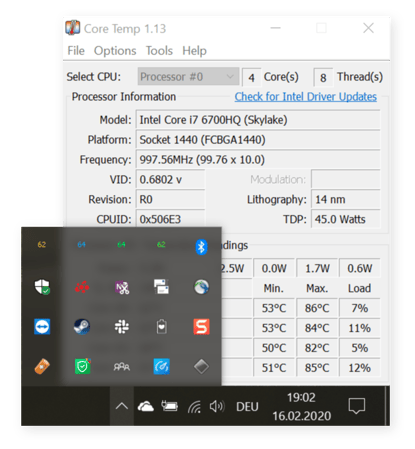
With Core Temp installed, click the small upward-pointing arrow in your taskbar to view your background applications.
-
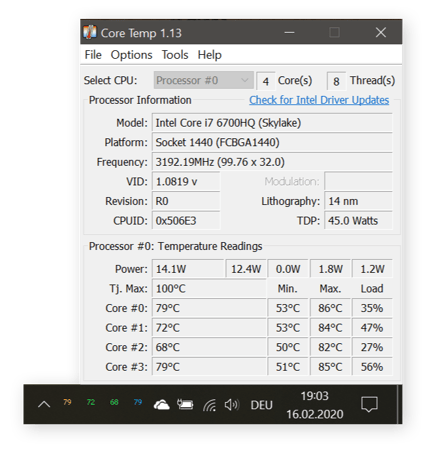
The multicolored numbers at the top represent the current temperatures of your CPU cores. You can look into them hither anytime you like, or click and drag out them to the taskbar to display them permanently.
-
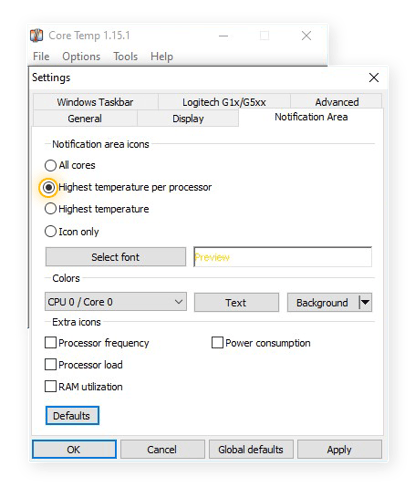
To conserve space in your taskbar, you can elect to view only the highest temperature at any given time. In Core Temp, manoeuvre to Options > Settings > Notification Area, and so select Highest temperature per processor.
Monitoring CPU temps in fullscreen mode
You can't view your taskbar while fullscreening a crippled or movie, thusly we'll need another solution if you'd like to keep an middle on your Central processor temps during those activities. Bundled with the GPU overclocking utility MSI Afterburner is a nifty little tool called RivaTuner, which leave let you display your Central processor temps even while in fullscreen mode.
You can also download RivaTuner on its own, but its developer recommends that you run it together with MSI Afterburner for optimum performance. Hera's how to get IT order for fullscreen temperature monitoring:
-
After installing MSI Afterburner and RivaTuner, open your desktop apps and click on the MSI Afterburner icon.

-
Open the Settings and pilot to the Monitoring tab. Whorl down pat and click Central processor Temperature, then select the box for Show in Along-Screen Display.

-
Switch to the Happening-Screen Display tab and choose a hotkey form that you'll use to bring risen your monitoring information. Anytime you'Re in a fullscreen app, you can input your hotkeys to panoram your CPU temps.

What temperature should my CPU be?
Under typical portion, your Central processor temp should remain between 40 and 65 degrees Celsius (or 104°F and 149°F). Your PC temperature may vary depending on your computer, CPU, and level of activity, only anything inside that window is normal and fine.
The normal CPU temp for your PC may motley dependent on what you have. For example, in a upper-end, custom-built play Microcomputer with loads of expensive cooling equipment, temps of just about 50 degrees Celsius (122°F) are not unusual. A powerful laptop computer, happening the strange hand, might extend to at around 75 degrees Celsius (167°F), due to the constricted space and temperature reduction options.
When pushed near its limits, CPU temps can exceed 80 degrees Celsius (176°F). This isn't inevitably a cause for alarm, only father't let your estimator stay at this heat level for long if you can avoid it, or you may experience performance slowdowns.
Extended gaming sessions potty also stress your graphics processing unit (GPU), so be aware that you'll want to check and monitor your GPU temperature as intimately. This is especially heavy if you've installed a high-end GPU designed for optimal gaming execution, since you'll likely be performin for hours at a time.
Sustained heat of all over 90 degrees Anders Celsius (194°F) butt cause physical equipment casualty to your CPU, so if you'ray seeing numbers like that for several consecutive days, take steps to reduce the song you're putting on your CPU. Numbers like this mean your CPU temp is as well gamey.
Does CPU temperature affect performance?
As mentioned above, your computer can and will likely slow down if you run it at high temperatures for sustained periods of metre. At temperatures of 90 degrees Celsius (194°F) and above, your C.P.U. may self-throttle, or regulate its own activity, ready to reduce the generation of additional heat. In some cases, this can causa your 3 GHz central processor to throttle down to 800 MHz, for example, significantly reducing your performance. Some CPUs may shut down entirely to keep off irreversible price from the commanding temperatures.
That's wherefore it's crucial to monitor your CPU temps on a daily fundament. It's especially useful if you're planning to boost your computer's public presentation via a CPU overclock. Overclocking is a popular technique to wheedle more power out of a play computer, just information technology comes at the cost of increased temperatures. We'd totally love to run GTA V at optimal graphical fidelity and physical body rates, but computer hardware has its limits.
Without sufficient cooling measures, you might consort into disoblige if you crusade things overly far. That's why so many custom-built gaming PCs purpose weewe chilling to increase performance. Since temperatures commode directly impact performance, you'll want to control your computer's heat output in order to quicken your information processing system.
Also, umpteen types of malware place a heavy strain happening your CPU, lead to an increase in temperature. Always use a reliable antivirus tool like AVG AntiVirus FREE to detect, block, and move out malware from your reckoner.
How to lower your CPU temperature
As a first-year step to lowering your CPU temp, improve the airflow to your computer. Place your laptop computer on a smooth, firm surface like a table surgery desk (not your bed!). The same goes for your screen background Microcomputer: keep it off the carpet. Also consider using a laptop computer chilling stand to supply your laptop with a steady stream of air. Most important, air cooling relies on the bare outdoor your computer being cooler than the air deep down it, so minimise your computer employ if your surround is too charged.
With a bit of exertion and a careful hand, you can perform some simple computer surgery to work your old PC back into tip-top shape and keep its temperatures dejected. Consumption a can of compressed air to clear whatsoever dust from the fans and vents, and supersede your Central processing unit's thermal paste. Thermal paste makes your CPU's heatsink Thomas More businesslike, which results in lower temperatures.
All computers get slower o'er time, and a whole lot of that lag is due to an accumulation of unneeded information. Thin down your awkward disk past removing bloatware and acquiring rid of any unwanted apps, then defrag your drive to give it a clean slate.
Stop overheating and boost performance in real time
An efficient computing machine is always going to run smoother, faster, and cooler than one that's overflowing with junk files and useless software. AVG TuneUp eliminates supernumerary baggage to absolve your Mainframe up for the tasks that in truth weigh — keeping temperatures down and performance up, all without any changes to your hardware.
how to check how hot your pc is
Source: https://www.avg.com/en/signal/check-cpu-temperature

Posting Komentar